
vLLM KV Cache 深度解析
📋 概述
KV Cache 是大语言模型推理中最重要的优化技术之一。本文档详细介绍 vLLM 中 KV Cache 的工作原理、实现细节和优化策略。
🧠 什么是 KV Cache?
在 Transformer 的自注意力机制中,每个 token 都需要与之前所有 token 进行注意力计算。如果每次生成新 token 都重新计算所有的 Key 和 Value 向量,计算量会非常大。
KV Cache 的核心思想:缓存已计算的 Key 和 Value 向量,避免重复计算。
数学原理
Attention(Q, K, V) = softmax(QK^T / √d_k) × V

其中:
- Q (Query): 当前 token 的查询向量
- K (Key): 所有 token 的键向量
- V (Value): 所有 token 的值向量
没有 KV Cache:
Step 1: 计算 token_0 的 K_0, V_0 → 生成 token_1
Step 2: 计算 token_0, token_1 的 K_0, K_1, V_0, V_1 → 生成 token_2
Step 3: 计算 token_0, token_1, token_2 的 K, V → 生成 token_3
...
计算复杂度: O(n²) 随序列长度平方增长
有 KV Cache:
Step 1: 计算并缓存 K_0, V_0 → 生成 token_1
Step 2: 使用缓存的 K_0, V_0,只计算新的 K_1, V_1 并缓存 → 生成 token_2
Step 3: 使用缓存的 K_0, K_1, V_0, V_1,只计算 K_2, V_2 并缓存 → 生成 token_3
...
计算复杂度: O(n) 线性增长
🎯 传统 KV Cache 的问题
内存碎片化
传统实现为每个请求预分配固定大小的连续内存:
┌─────────────────────────────────────────────────┐
│ Request A: [████████████____________]           │ ← 预分配 max_seq_len
│            实际使用      预留但未使用            │
├─────────────────────────────────────────────────┤
│ Request B: [████_______________]                │ ← 短请求浪费更多
├─────────────────────────────────────────────────┤
│ Request C: [████████████████████████████████]   │ ← 长请求可能超出
└─────────────────────────────────────────────────┘
问题:
- 内存浪费:预分配但未使用的内存高达 60-80%
- 批大小受限:因碎片化无法充分利用 GPU 内存
- 不灵活:无法适应变长序列
🚀 vLLM 的 PagedAttention 方案
vLLM 提出了 PagedAttention,借鉴操作系统虚拟内存的分页机制,将 KV Cache 切分为固定大小的块(block)进行管理。
核心设计
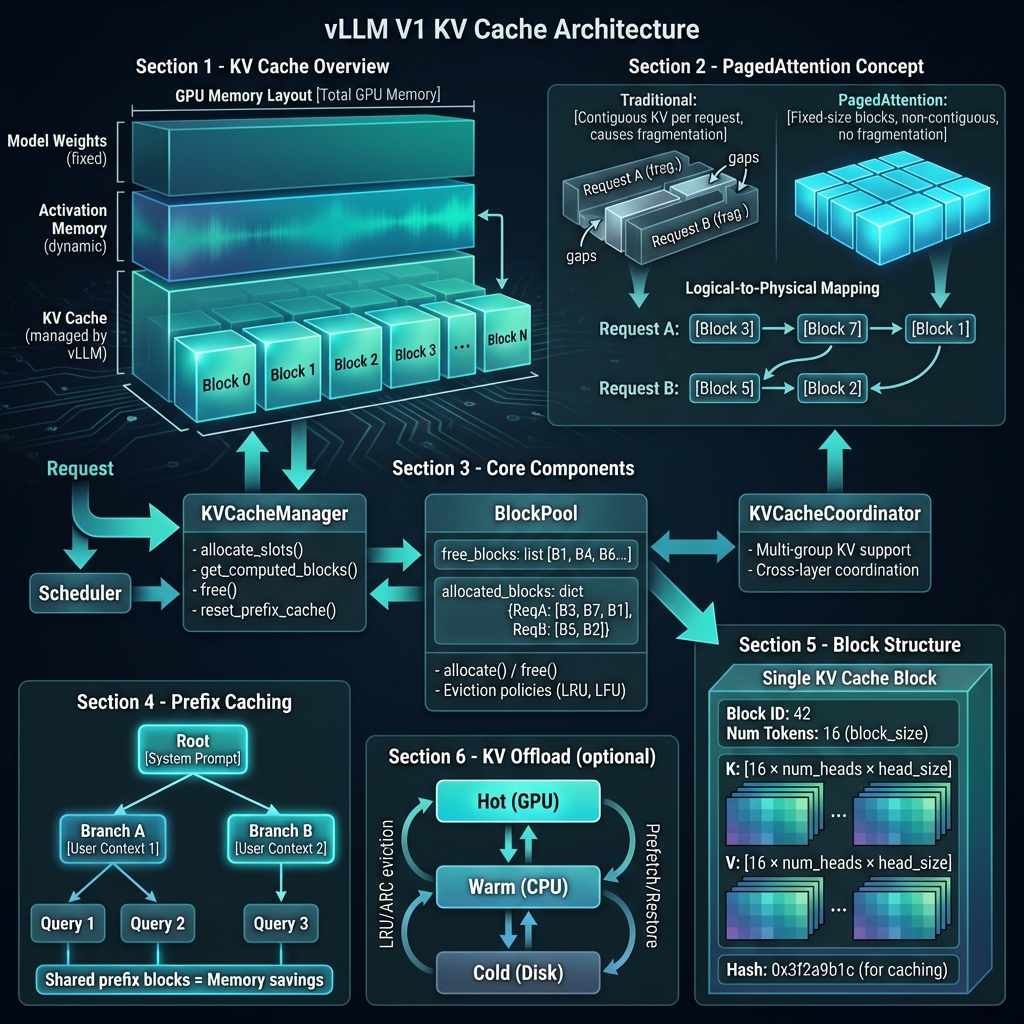
关键概念:
| 概念 | 说明 | |------|------| | Block | 固定大小的 KV 存储单元,通常 16 tokens | | Block Size | 每个块存储的 token 数量 | | Block Table | 逻辑块到物理块的映射表 | | Block Pool | 管理所有可用块的池 |
块结构
# 单个 KV Cache 块的结构
Block {
    block_id: int           # 物理块 ID
    num_tokens: int         # 已填充的 token 数 (0 ~ block_size)

    # 每层每头的 KV 向量
    k_cache: [block_size, num_heads, head_size]  # Key 缓存
    v_cache: [block_size, num_heads, head_size]  # Value 缓存

    # 用于前缀缓存的哈希值
    block_hash: Optional[int]
}
非连续内存分配
传统连续分配:
Request A: [Block 0][Block 1][Block 2][Block 3] ← 必须连续

PagedAttention 非连续分配:
Request A: [Block 0] → [Block 5] → [Block 2] → [Block 8]
                  ↓          ↓          ↓          ↓
           物理位置不连续,通过 Block Table 映射
📊 KV Cache 演变过程
推理过程中的 KV Cache 变化
下图展示了单个请求从 Prefill 到 Decode 阶段 KV Cache 的变化:
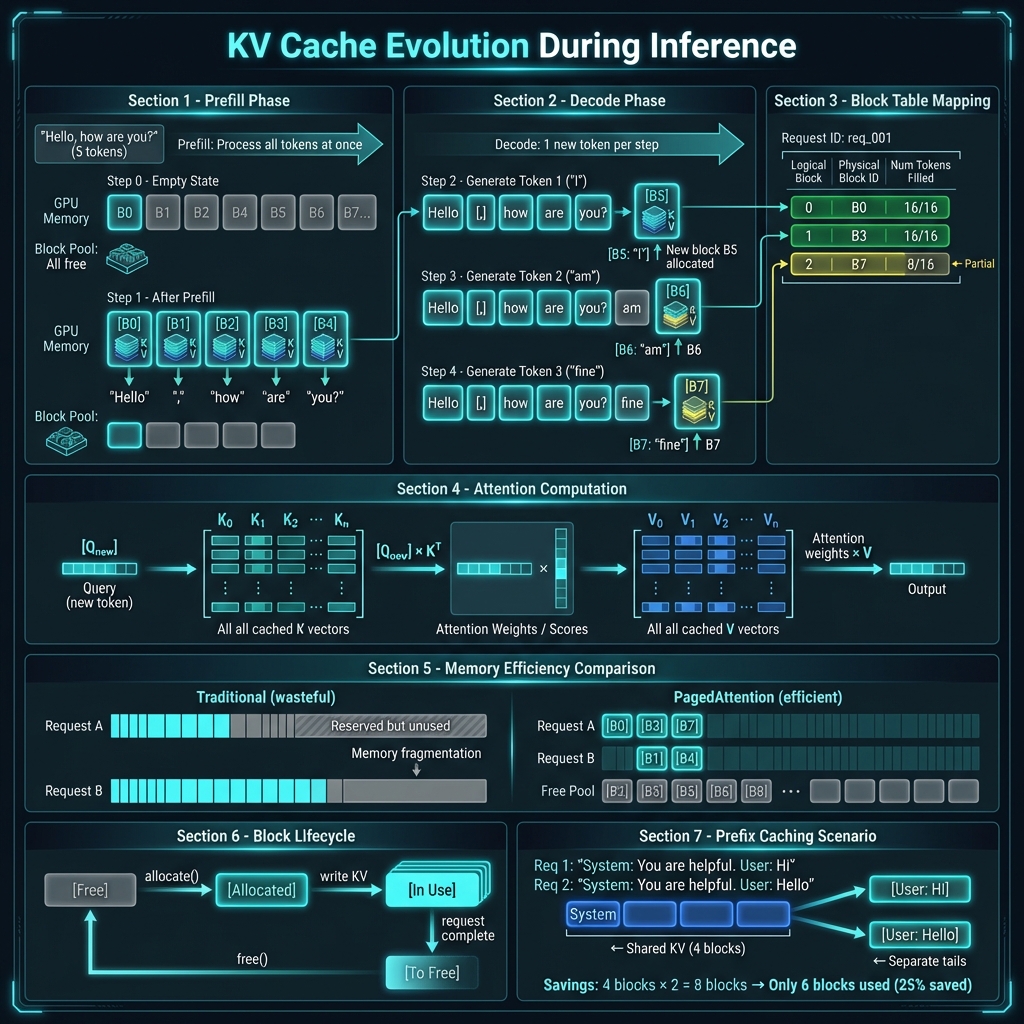
Phase 1: Prefill(预填充阶段)
输入 Prompt: "Hello, how are you?" (5 tokens)

1. 一次性计算所有 token 的 K, V
2. 分配足够的块存储这些 KV
3. 块状态: [B0: full][B1: partial]

GPU 计算: 并行处理所有 5 个 token
内存操作: 批量写入 KV Cache
Phase 2: Decode(解码阶段)
生成第 1 个 token: "I"
├─ Query: 只有新 token
├─ Key/Value: 新 token + 缓存的所有 KV
├─ 写入新的 K, V 到当前块 (B1)
└─ 如果块满,分配新块

生成第 2 个 token: "am"
├─ 同上,累积 KV Cache
└─ ...

生成第 N 个 token:
├─ KV Cache 持续增长
└─ 动态分配新块
多请求批处理场景
下图展示了多个并发请求同时运行时 KV Cache 的动态变化:
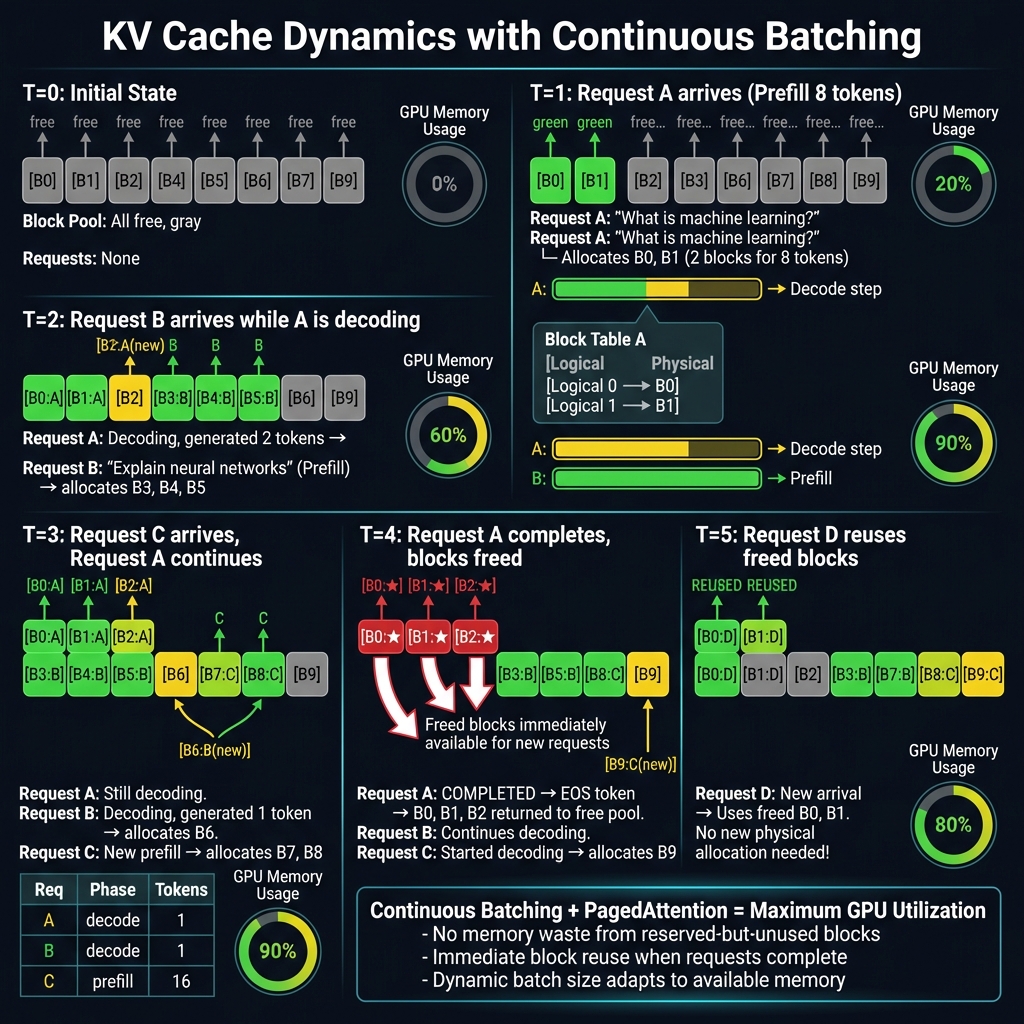
Timeline 详解
| 时间 | 事件 | Block Pool 状态 | GPU 内存使用 | |------|------|-----------------|--------------| | T=0 | 初始状态 | 所有块空闲 | 0% | | T=1 | Request A Prefill | B0, B1 分配给 A | 20% | | T=2 | Request B 加入 | B3-B5 分配给 B,B2 分配给 A | 60% | | T=3 | Request C 加入 | B7-B8 分配给 C,B6 分配给 B | 90% | | T=4 | Request A 完成 | B0-B2 释放回池 | 70% | | T=5 | Request D 复用 | B0, B1 被 D 复用 | 80% |
关键洞察:
- 块在请求完成后立即释放
- 新请求可以复用已释放的块
- 无需预分配固定大小内存
- GPU 利用率可达 90%+
🔧 核心组件详解
1. BlockPool(块池)
class BlockPool:
    """管理所有 KV Cache 块的池"""

    def __init__(self, num_blocks: int, block_size: int):
        self.free_blocks: List[int] = list(range(num_blocks))
        self.allocated_blocks: Dict[str, List[int]] = {}

    def allocate(self, request_id: str) -> int:
        """从池中分配一个块"""
        if not self.free_blocks:
            raise OutOfMemoryError("No free blocks available")
        block_id = self.free_blocks.pop()
        self.allocated_blocks.setdefault(request_id, []).append(block_id)
        return block_id

    def free(self, request_id: str):
        """释放请求的所有块"""
        blocks = self.allocated_blocks.pop(request_id, [])
        self.free_blocks.extend(blocks)
2. KVCacheManager(缓存管理器)
class KVCacheManager:
    """KV Cache 的高级管理接口"""

    def get_computed_blocks(self, request: Request) -> Tuple[List[Block], int]:
        """获取请求的已计算块(用于前缀缓存)"""
        # 检查是否有可复用的前缀
        cached_blocks = self.prefix_cache.lookup(request.prompt_hash)
        return cached_blocks, len(cached_blocks) * self.block_size

    def allocate_slots(self, request: Request, num_tokens: int) -> List[int]:
        """为新 token 分配 KV 槽位"""
        required_blocks = ceil(num_tokens / self.block_size)
        allocated = []
        for _ in range(required_blocks):
            block = self.block_pool.allocate(request.request_id)
            allocated.append(block)
        return allocated

    def free(self, request: Request):
        """释放请求的所有 KV Cache"""
        self.block_pool.free(request.request_id)
3. Block Table(块表)
# 逻辑块到物理块的映射
class BlockTable:
    """
    Request 的块映射表

    Logical Index:  [0,  1,  2,  3,  4]
                     ↓   ↓   ↓   ↓   ↓
    Physical Block: [B0, B5, B2, B8, B3]
    """

    def __init__(self):
        self.mapping: List[int] = []  # logical_idx -> physical_block_id

    def append(self, physical_block_id: int):
        self.mapping.append(physical_block_id)

    def get_physical_blocks(self) -> List[int]:
        return self.mapping
🌳 前缀缓存 (Prefix Caching)
原理
当多个请求共享相同的前缀(如系统提示词)时,可以复用已计算的 KV Cache。
Request 1: "System: You are a helpful assistant. User: Hi"
Request 2: "System: You are a helpful assistant. User: Hello"
Request 3: "System: You are a helpful assistant. User: Help me"
           └──────────────共同前缀──────────────┘└─不同部分─┘
实现
# 前缀缓存使用树状结构
class PrefixCache:
    """
    树状结构存储前缀

           [Root]
              │
    [System: You are helpful]  ← 共享块 (Block 0-3)
         /        |        \
    [User: Hi] [User: Hello] [User: Help]
    (Block 4)   (Block 5)    (Block 6)
    """

    def lookup(self, token_ids: List[int]) -> List[Block]:
        """查找可复用的前缀块"""
        hash_key = self.compute_hash(token_ids)
        return self.cache.get(hash_key, [])

    def insert(self, token_ids: List[int], blocks: List[Block]):
        """插入新的前缀到缓存"""
        hash_key = self.compute_hash(token_ids)
        self.cache[hash_key] = blocks
节省效果
不使用前缀缓存:
- Request 1: 5 blocks
- Request 2: 5 blocks
- Request 3: 5 blocks
- 总计: 15 blocks

使用前缀缓存:
- 共享前缀: 4 blocks (只计算一次)
- Request 1 后缀: 1 block
- Request 2 后缀: 1 block
- Request 3 后缀: 1 block
- 总计: 7 blocks (节省 53%!)
💾 KV Offload(缓存卸载)
对于超长上下文,GPU 内存可能不足。vLLM 支持将部分 KV Cache 卸载到 CPU 或磁盘。
分层架构
┌─────────────────────────────────────────┐
│           Hot (GPU Memory)              │ ← 最近使用,访问最快
│  ┌─────┐ ┌─────┐ ┌─────┐ ┌─────┐       │
│  │ B0  │ │ B1  │ │ B2  │ │ B3  │       │
│  └─────┘ └─────┘ └─────┘ └─────┘       │
└─────────────────────────────────────────┘
                    ↕ LRU/ARC eviction
┌─────────────────────────────────────────┐
│           Warm (CPU Memory)             │ ← 较少使用,访问较慢
│  ┌─────┐ ┌─────┐ ┌─────┐ ┌─────┐       │
│  │ B4  │ │ B5  │ │ B6  │ │ B7  │       │
│  └─────┘ └─────┘ └─────┘ └─────┘       │
└─────────────────────────────────────────┘
                    ↕ eviction
┌─────────────────────────────────────────┐
│           Cold (Disk/SSD)               │ ← 很少使用,访问最慢
│  ┌─────┐ ┌─────┐ ┌─────┐ ┌─────┐       │
│  │ B8  │ │ B9  │ │ B10 │ │ ... │       │
│  └─────┘ └─────┘ └─────┘ └─────┘       │
└─────────────────────────────────────────┘
驱逐策略
| 策略 | 说明 | |------|------| | LRU | Least Recently Used,最近最少使用 | | ARC | Adaptive Replacement Cache,自适应替换 |
📈 性能优化技术
1. CUDA Graphs
减少 CPU-GPU 通信开销:
# 首次运行:捕获计算图
with torch.cuda.graph(graph):
    output = model(input)

# 后续运行:重放计算图
graph.replay()  # 极低的 CPU 开销
2. Slot Mapping 优化
# 将逻辑位置映射到物理位置
slot_mapping = torch.tensor([
    block_table[logical_idx] * block_size + offset
    for logical_idx, offset in token_positions
])

# 使用索引直接写入 KV Cache
kv_cache[slot_mapping] = new_kv
3. Flash Attention 集成
# Flash Attention 支持分页 KV Cache
flash_attn_with_kvcache(
    q=query,                    # [batch, 1, heads, head_dim]
    k_cache=k_cache,            # [num_blocks, block_size, heads, head_dim]
    v_cache=v_cache,            # [num_blocks, block_size, heads, head_dim]
    block_table=block_table,    # [batch, max_blocks]
    cache_seqlens=seq_lens,     # [batch]
)
📊 内存计算
KV Cache 大小公式
单层 KV Cache 大小 = 2 × num_heads × head_size × seq_len × dtype_size

总 KV Cache 大小 = num_layers × 单层大小

示例 (Llama-2-7B):
- num_layers = 32
- num_heads = 32
- head_size = 128
- seq_len = 4096
- dtype = float16 (2 bytes)

单层 = 2 × 32 × 128 × 4096 × 2 = 64 MB
总计 = 32 × 64 MB = 2 GB per request!
块数量计算
所需块数 = ceil(seq_len / block_size)

示例:
- seq_len = 4096
- block_size = 16
- 所需块数 = ceil(4096 / 16) = 256 blocks
🔗 相关代码位置
| 模块 | 文件路径 | 说明 |
|------|----------|------|
| KV Cache 管理器 | vllm/v1/core/kv_cache_manager.py | 高级管理接口 |
| 块池 | vllm/v1/core/block_pool.py | 块分配/释放 |
| KV Cache 工具 | vllm/v1/core/kv_cache_utils.py | 辅助函数 (66KB) |
| 块表 | vllm/v1/worker/block_table.py | 块映射表 |
| Attention 后端 | vllm/v1/attention/backends/ | 各种注意力实现 |
| KV Offload | vllm/v1/kv_offload/ | 缓存卸载 |
📚 参考资料
- vLLM: Easy, Fast, and Cheap LLM Serving with PagedAttention
- FlashAttention-2: Faster Attention with Better Parallelism
- vLLM 官方文档
🎯 总结
vLLM 的 KV Cache 管理通过以下创新实现了高效内存利用:
| 技术 | 效果 | |------|------| | PagedAttention | 消除内存碎片,提高利用率 50%+ | | 非连续分配 | 灵活的内存管理 | | 前缀缓存 | 共享计算,减少重复 | | 动态分配 | 按需分配,无浪费 | | 即时释放 | 块可立即复用 | | KV Offload | 支持超长上下文 |
这些技术共同使 vLLM 成为目前最高效的开源 LLM 推理引擎之一。