
vLLM V1 架构详解
📋 概述
vLLM V1 是 vLLM 项目的新一代推理引擎架构,相比旧版进行了全面的模块化重构。本文档详细介绍 V1 架构中各模块的功能和交互关系。
🏗️ 整体架构
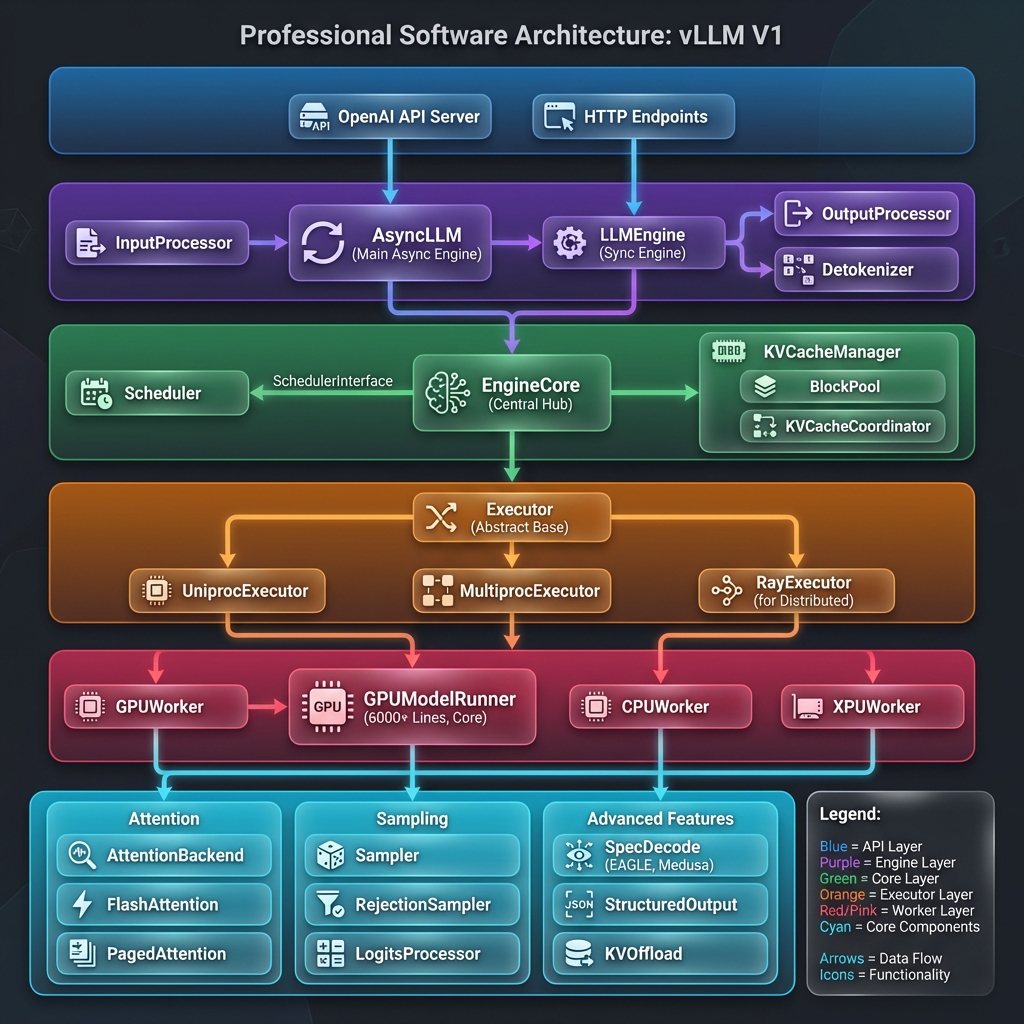
vLLM V1 采用分层架构设计,从上到下分为以下几层:
┌─────────────────────────────────────────────────────────────┐
│                    API Layer (API 层)                       │
│              OpenAI API Server / HTTP Endpoints             │
├─────────────────────────────────────────────────────────────┤
│                   Engine Layer (引擎层)                      │
│     AsyncLLM / LLMEngine / InputProcessor / Detokenizer     │
├─────────────────────────────────────────────────────────────┤
│                    Core Layer (核心层)                       │
│        EngineCore / Scheduler / KVCacheManager              │
├─────────────────────────────────────────────────────────────┤
│                  Executor Layer (执行器层)                   │
│      UniprocExecutor / MultiprocExecutor / RayExecutor      │
├─────────────────────────────────────────────────────────────┤
│                   Worker Layer (工作节点层)                  │
│        GPUWorker / GPUModelRunner / CPUWorker               │
├─────────────────────────────────────────────────────────────┤
│               Core Components (核心组件层)                   │
│   Attention / Sampling / SpecDecode / StructuredOutput     │
└─────────────────────────────────────────────────────────────┘
📁 模块详解
1. 🚀 Engine (引擎模块) - vllm/v1/engine/
引擎模块是 vLLM 的入口点,负责处理用户请求的完整生命周期。
| 文件 | 核心类 | 功能说明 |
|------|--------|----------|
| async_llm.py | AsyncLLM | 异步引擎,支持并发请求处理,是生产环境的主要接口 |
| llm_engine.py | LLMEngine | 同步引擎,用于简单场景和测试 |
| core.py | EngineCore | 引擎核心逻辑,协调调度器和执行器 |
| core_client.py | EngineCoreClient | 引擎核心的客户端封装 |
| input_processor.py | InputProcessor | 输入预处理,包括 tokenization 和多模态处理 |
| output_processor.py | OutputProcessor | 输出后处理,构建最终响应 |
| detokenizer.py | Detokenizer | 将 token ID 转换回文本 |
| logprobs.py | - | Log 概率计算工具 |
核心流程:
# EngineCore.step() 的核心循环
def step(self):
    # 1. 调度 - 决定本次迭代处理哪些请求
    scheduler_output = self.scheduler.schedule()

    # 2. 执行 - 运行模型前向传播
    model_output = self.executor.execute_model(scheduler_output)

    # 3. 更新 - 处理输出并更新状态
    outputs = self.scheduler.update_from_output(scheduler_output, model_output)

    return outputs
2. 📊 Core (核心调度模块) - vllm/v1/core/
核心模块负责请求调度和 KV Cache 管理,是 vLLM 高性能的关键。
2.1 调度器 (sched/)
| 文件 | 核心类 | 功能说明 |
|------|--------|----------|
| interface.py | SchedulerInterface | 调度器抽象接口 |
| scheduler.py | Scheduler | 主调度器实现 (99KB,核心逻辑) |
| async_scheduler.py | AsyncScheduler | 异步调度器 |
| output.py | SchedulerOutput | 调度输出数据结构 |
| request_queue.py | RequestQueue | 请求队列管理 |
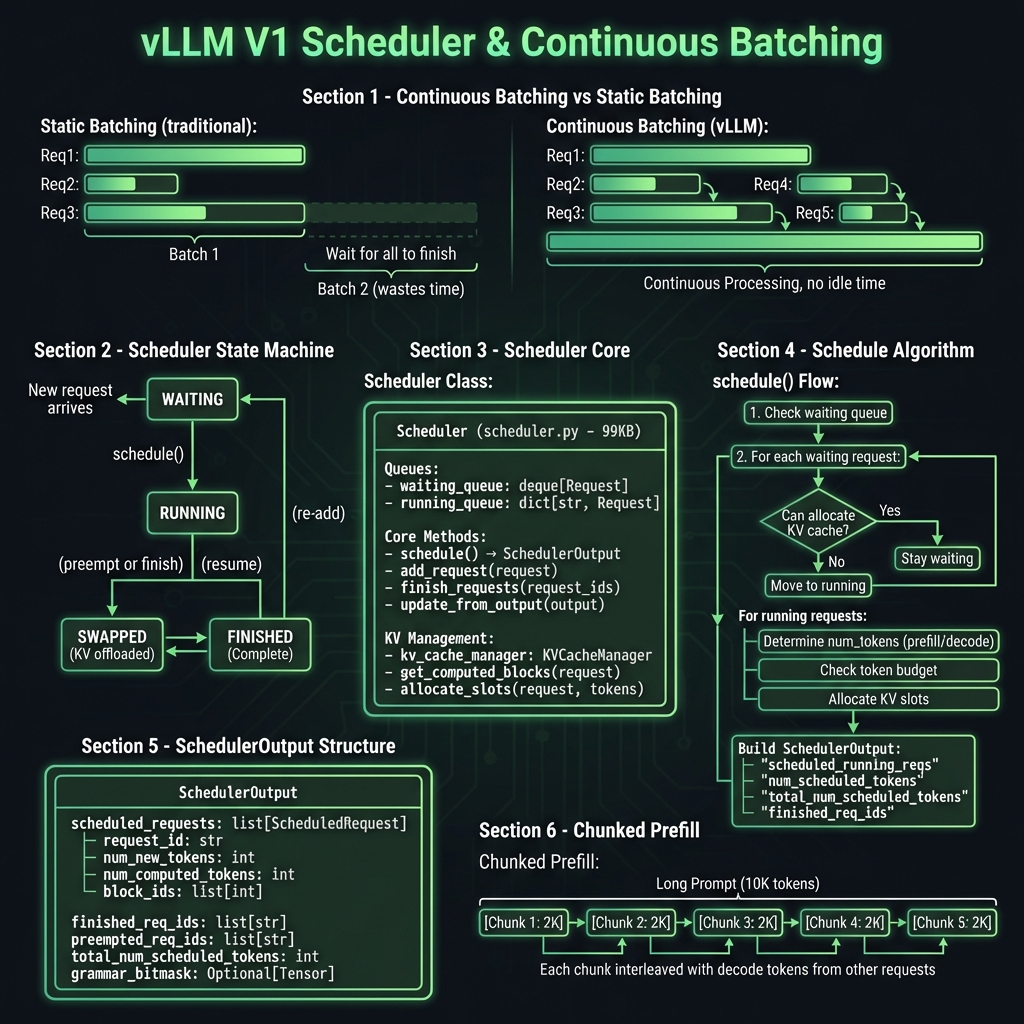
调度器核心功能:
- 管理 waiting queue (等待队列) 和 running queue (运行队列)
- 实现 Continuous Batching (连续批处理)
- 支持 Chunked Prefill (分块预填充)
- 与 KV Cache 管理器协调内存分配
2.2 KV Cache 管理
| 文件 | 核心类 | 功能说明 |
|------|--------|----------|
| kv_cache_manager.py | KVCacheManager | KV Cache 管理器主接口 |
| single_type_kv_cache_manager.py | SingleTypeKVCacheManager | 单类型 KV Cache 管理 |
| kv_cache_coordinator.py | KVCacheCoordinator | 多类型 KV Cache 协调 |
| block_pool.py | BlockPool | 内存块池管理 |
| kv_cache_utils.py | - | KV Cache 工具函数 (66KB) |
| encoder_cache_manager.py | EncoderCacheManager | 编码器缓存 (多模态) |
KV Cache 管理特性:
- PagedAttention: 分页式 KV Cache,避免内存碎片
- Prefix Caching: 前缀缓存,复用相同前缀的 KV
- Block Pool: 块池管理,高效的内存分配/释放
3. ⚡ Executor (执行器模块) - vllm/v1/executor/
执行器负责将计算任务分发到不同的执行环境。
| 文件 | 核心类 | 功能说明 |
|------|--------|----------|
| abstract.py | Executor | 执行器抽象基类 |
| uniproc_executor.py | UniprocExecutor | 单进程执行器 |
| multiproc_executor.py | MultiprocExecutor | 多进程执行器 (Tensor Parallel) |
| ray_executor.py | RayExecutor | Ray 分布式执行器 |
| ray_utils.py | - | Ray 工具函数 |
执行模式:
单 GPU:     UniprocExecutor → 1 GPUWorker
多 GPU TP:  MultiprocExecutor → N GPUWorkers (Tensor Parallel)
分布式:     RayExecutor → 跨节点 GPUWorkers
4. 👷 Worker (工作节点模块) - vllm/v1/worker/
工作节点是实际执行模型推理的组件。
| 文件 | 核心类 | 功能说明 | 代码规模 |
|------|--------|----------|----------|
| gpu_model_runner.py | GPUModelRunner | GPU 模型运行器 (核心) | 6067 行 |
| gpu_worker.py | GPUWorker | GPU 工作节点 | 41KB |
| gpu_input_batch.py | InputBatch | GPU 输入批处理 | 44KB |
| cpu_model_runner.py | CPUModelRunner | CPU 模型运行器 | 4KB |
| cpu_worker.py | CPUWorker | CPU 工作节点 | 8KB |
| xpu_model_runner.py | XPUModelRunner | Intel XPU 运行器 | 1KB |
| xpu_worker.py | XPUWorker | Intel XPU 工作节点 | 7KB |
| block_table.py | BlockTable | 块表管理 | 14KB |
| worker_base.py | WorkerBase | 工作节点基类 | 14KB |
GPUModelRunner 核心方法:
class GPUModelRunner:
    def __init__(self, vllm_config, device):
        # 初始化模型、注意力后端、采样器等

    def load_model(self):
        # 加载模型权重

    def execute_model(self, scheduler_output):
        # 1. 准备输入 (tokens, positions, attention metadata)
        # 2. 模型前向传播
        # 3. 采样生成 token
        # 4. 返回 ModelRunnerOutput
5. 👁️ Attention (注意力模块) - vllm/v1/attention/
注意力模块实现高效的注意力计算。
| 文件/目录 | 功能说明 |
|-----------|----------|
| backend.py | 注意力后端抽象基类 AttentionBackend |
| selector.py | 自动选择最优注意力后端 |
| backends/ | 具体后端实现 |
| ops/ | 注意力算子 |
支持的注意力后端:
- FlashAttention V2/V3: NVIDIA GPU 优化
- FlashInfer: 高性能推理优化
- PagedAttention: vLLM 原生分页注意力
- MLA (Multi-Latent Attention): DeepSeek 模型支持
6. 🎲 Sample (采样模块) - vllm/v1/sample/
采样模块负责从模型输出概率分布中采样 token。
| 文件/目录 | 核心类 | 功能说明 |
|-----------|--------|----------|
| sampler.py | Sampler | 主采样器 |
| rejection_sampler.py | RejectionSampler | 拒绝采样 (推测解码) |
| metadata.py | SamplingMetadata | 采样元数据 |
| logits_processor/ | - | Logits 处理器 |
| ops/ | - | 采样算子 |
采样流程:
def sample(logits, sampling_metadata):
    # 1. 应用温度 (temperature)
    # 2. 应用惩罚 (repetition, frequency, presence)
    # 3. 应用 logits processor
    # 4. Top-K / Top-P 过滤
    # 5. 采样或 argmax (greedy)
    # 6. 计算 logprobs (如需要)
7. 🚄 Spec Decode (推测解码模块) - vllm/v1/spec_decode/
推测解码通过并行验证加速生成。
| 文件 | 核心类 | 功能说明 |
|------|--------|----------|
| eagle.py | EAGLEDrafter | EAGLE 推测解码 (64KB,主力实现) |
| medusa.py | MedusaProposer | Medusa 多头推测 |
| draft_model.py | DraftModel | 草稿模型基类 |
| ngram_proposer.py | NgramProposer | N-gram 提议器 |
| suffix_decoding.py | - | 后缀解码 |
| metrics.py | - | 推测解码指标 |
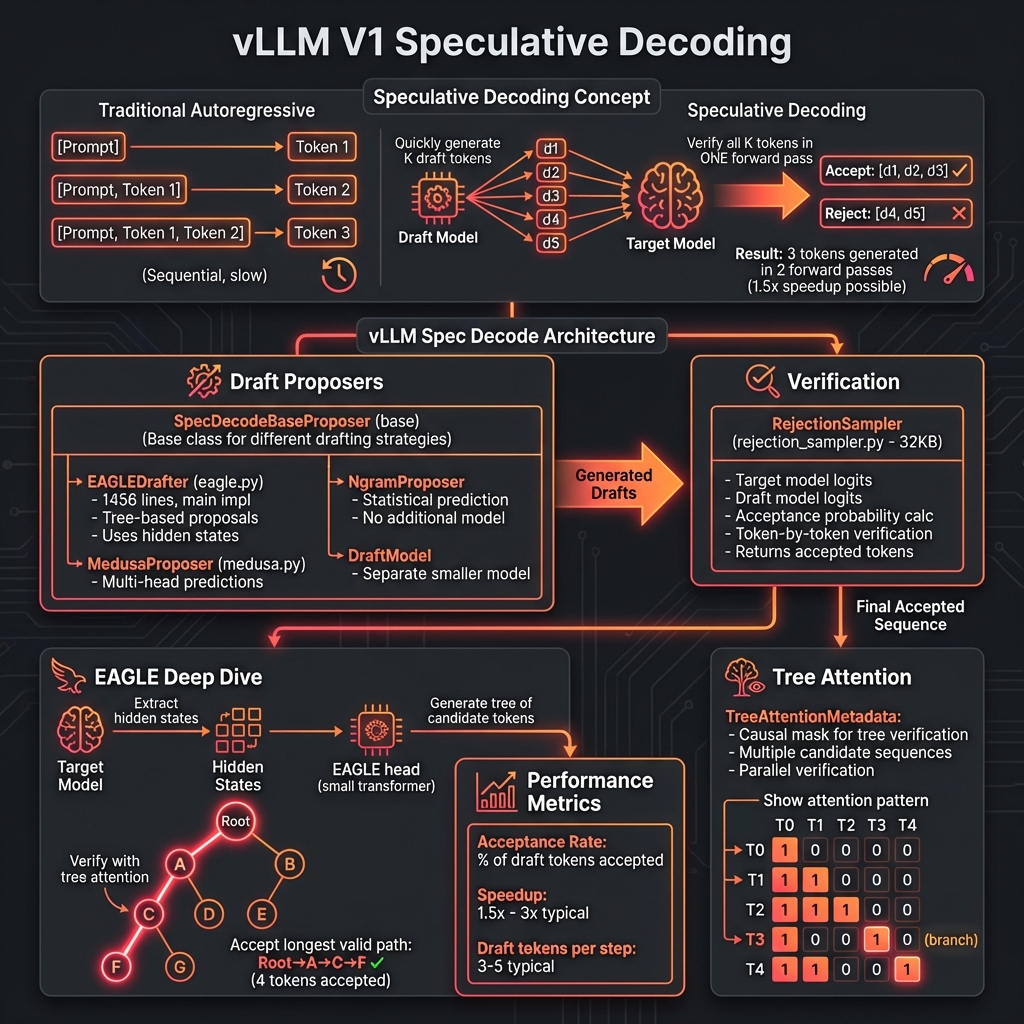
推测解码原理:
1. 草稿模型快速生成 K 个候选 token
2. 目标模型一次性验证所有候选
3. 接受正确的 token,拒绝错误的
4. 平均加速 2-3x
8. 📝 Structured Output (结构化输出模块) - vllm/v1/structured_output/
支持 JSON Schema、正则表达式等约束输出。
| 文件 | 功能说明 |
|------|----------|
| backend_xgrammar.py | XGrammar 后端 (推荐) |
| backend_outlines.py | Outlines 后端 |
| backend_guidance.py | Guidance 后端 |
| backend_lm_format_enforcer.py | LM Format Enforcer |
| backend_types.py | 后端类型定义 |
9. 💾 KV Offload (KV Cache 卸载模块) - vllm/v1/kv_offload/
将 KV Cache 卸载到 CPU/磁盘以支持更长上下文。
| 文件 | 功能说明 |
|------|----------|
| abstract.py | 卸载管理器抽象基类 |
| arc_manager.py | ARC 缓存策略 |
| lru_manager.py | LRU 缓存策略 |
| cpu.py | CPU 卸载实现 |
| backends/ | 具体后端 |
| worker/ | 卸载工作节点 |
10. 📈 Metrics (指标监控模块) - vllm/v1/metrics/
性能监控和指标收集。
| 文件 | 功能说明 |
|------|----------|
| loggers.py | 日志记录器 (49KB) |
| perf.py | 性能监控 (44KB) |
| prometheus.py | Prometheus 导出 |
| stats.py | 统计信息 |
| reader.py | 指标读取 |
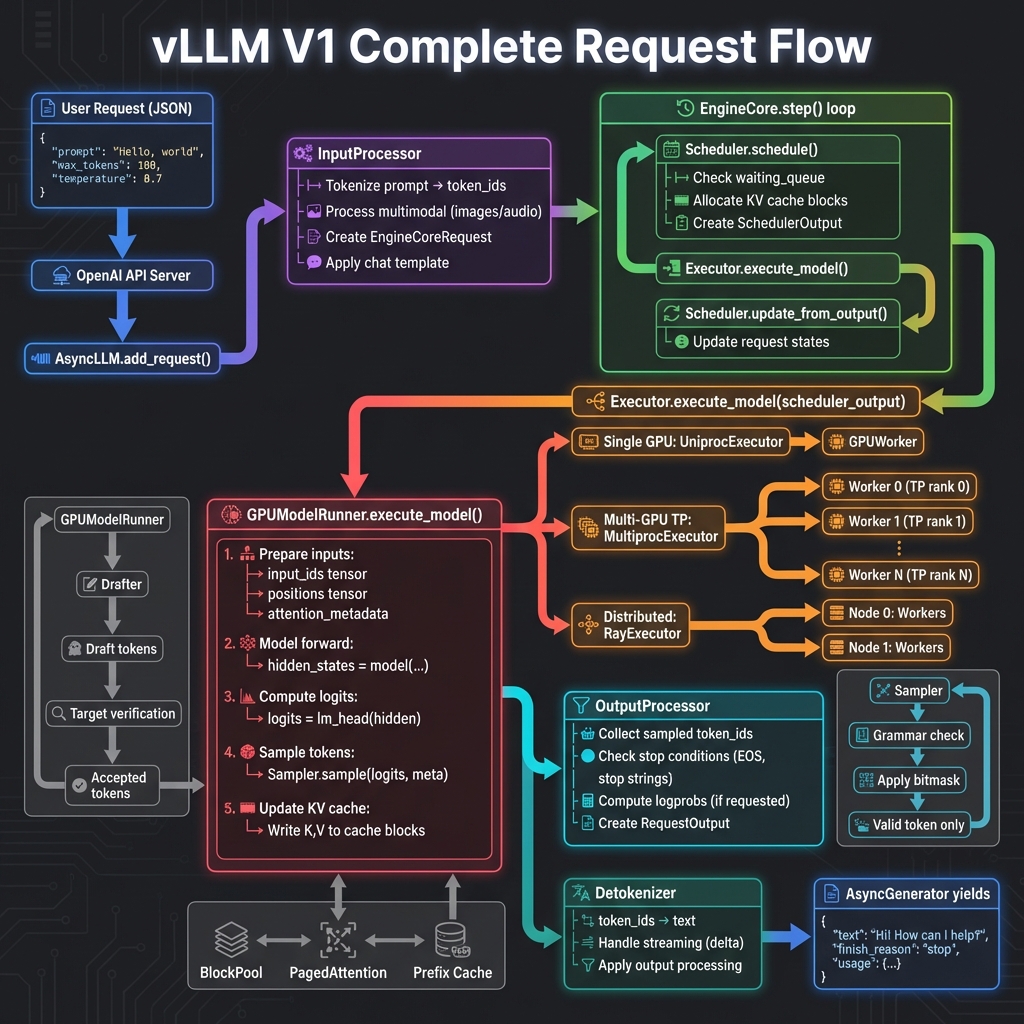
🔄 请求处理流程
用户请求
    │
    ▼
┌─────────────────┐
│  AsyncLLM      │ ← 接收请求
│  add_request() │
└────────┬────────┘
         │
         ▼
┌─────────────────┐
│ InputProcessor │ ← Tokenize + 多模态处理
│  process()     │
└────────┬────────┘
         │
         ▼
┌─────────────────┐
│  EngineCore    │ ← 核心调度循环
│    step()      │
└────────┬────────┘
         │
    ┌────┴────┐
    │         │
    ▼         ▼
┌────────┐  ┌─────────────────┐
│Scheduler│  │  KVCacheManager │
│schedule()│ │   allocate()    │
└────┬───┘  └────────┬────────┘
     │               │
     └───────┬───────┘
             │
             ▼
      SchedulerOutput
             │
             ▼
┌─────────────────┐
│   Executor     │ ← 分发执行
│ execute_model()│
└────────┬────────┘
         │
         ▼
┌─────────────────┐
│  GPUWorker     │
│  GPUModelRunner│ ← 实际推理
│ execute_model()│
└────────┬────────┘
         │
    ┌────┴────┐
    │         │
    ▼         ▼
┌────────┐  ┌─────────┐
│ Model  │  │ Sampler │
│Forward │→ │ sample()│
└────────┘  └────┬────┘
                 │
                 ▼
         ModelRunnerOutput
                 │
                 ▼
┌─────────────────┐
│  Detokenizer   │ ← 解码输出
│  detokenize()  │
└────────┬────────┘
         │
         ▼
      用户响应
🎯 总结
vLLM V1 架构的核心设计理念:
- 模块化: 各组件解耦,便于扩展和测试
- 高性能: PagedAttention + Continuous Batching
- 可扩展: 支持多种硬件后端和分布式部署
- 灵活性: 支持推测解码、结构化输出等高级特性
关键代码量统计:
gpu_model_runner.py: 6067 行 (核心推理逻辑)scheduler.py: 99KB (调度核心)kv_cache_utils.py: 66KB (KV Cache 工具)eagle.py: 64KB (EAGLE 推测解码)
📊 架构图
本文档配套以下架构图,位于 docs/images/ 目录:
1. vLLM V1 整体架构图
展示 V1 的分层架构设计,包括 API 层、引擎层、核心层、执行器层、工作节点层和核心组件层。
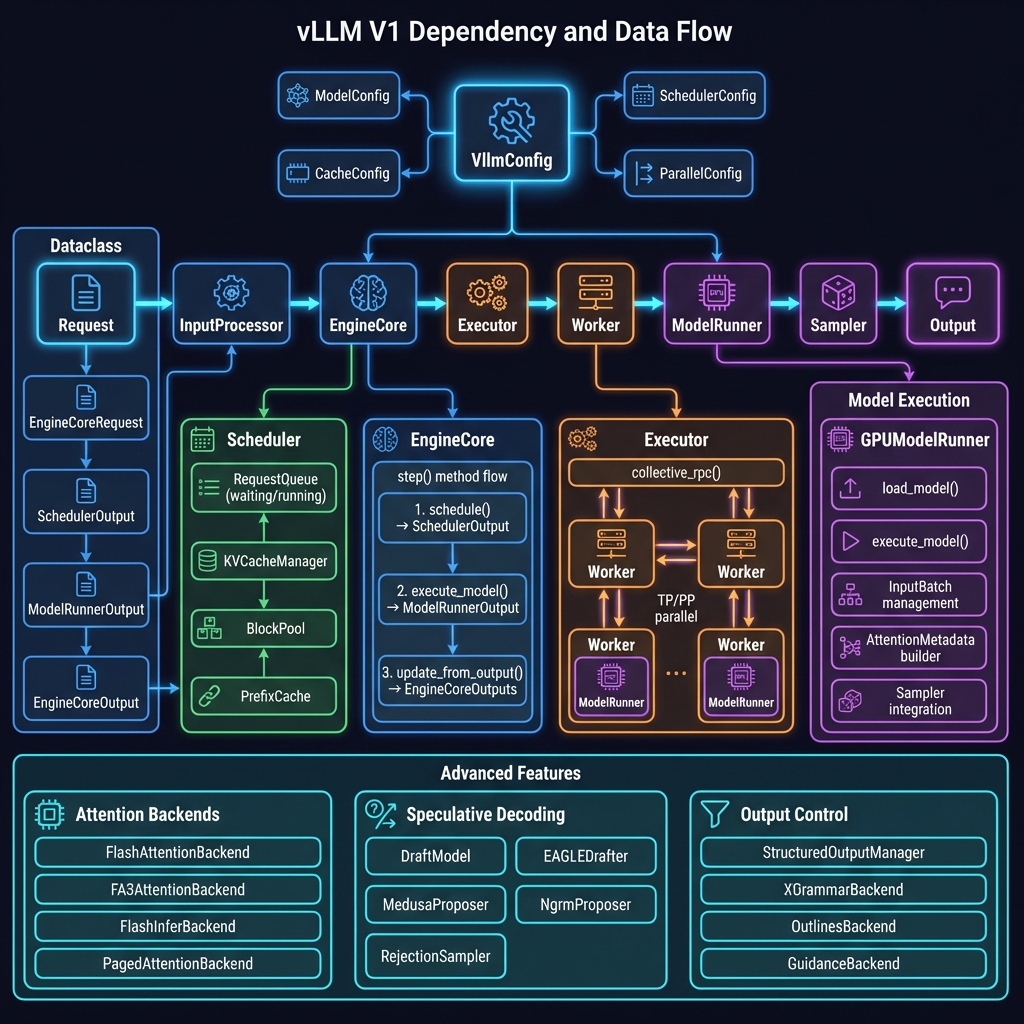
2. 模块依赖与数据流图
展示各模块之间的交互关系:VllmConfig 配置中心、请求处理流水线、EngineCore 核心循环等。
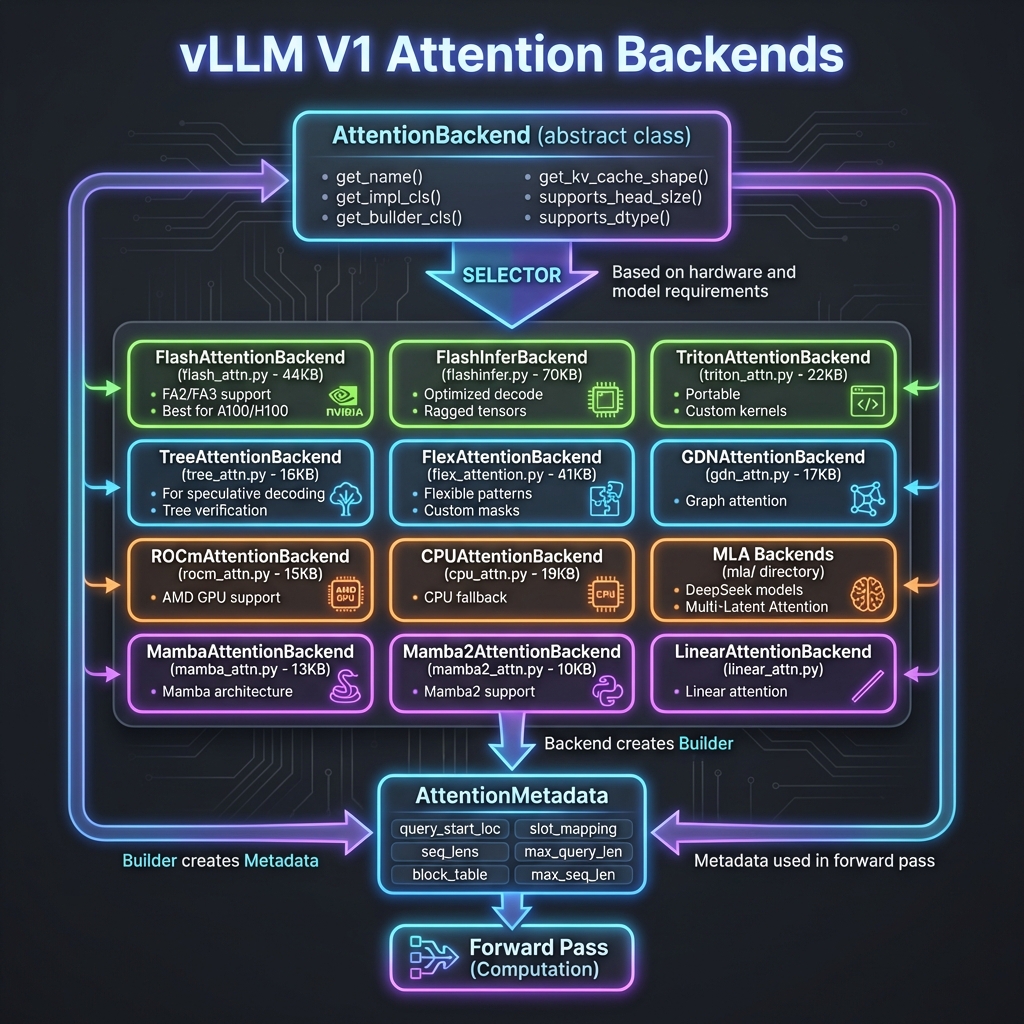
3. 注意力后端架构图
详细展示 20+ 种注意力后端实现:FlashAttention、FlashInfer、Tree Attention、Mamba 等。
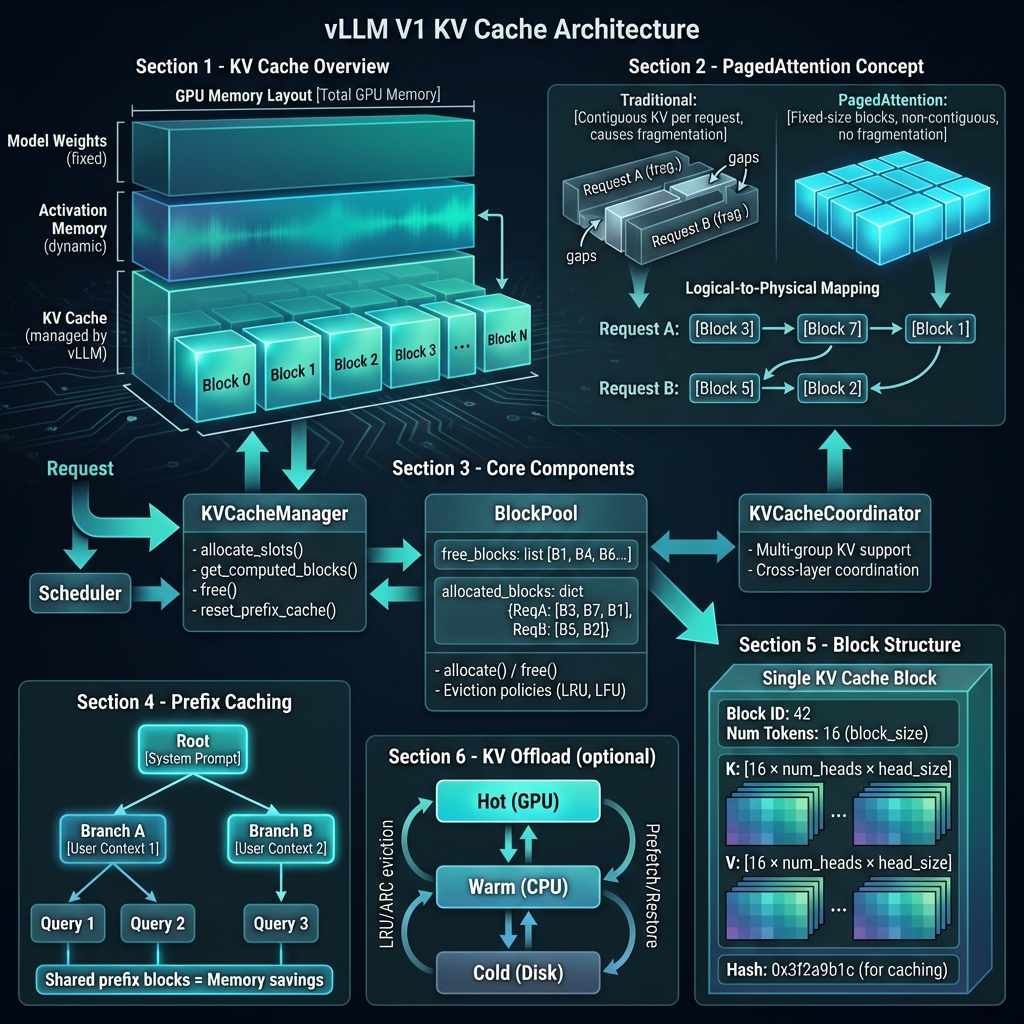
4. KV Cache 架构图
PagedAttention 核心原理:GPU 内存布局、逻辑到物理块映射、前缀缓存、KV Offload。
5. 推测解码架构图
推测解码加速技术:EAGLE、Medusa、Ngram 提议器,拒绝采样验证流程。
6. 调度器架构图
Continuous Batching 和调度:请求状态机、Scheduler 核心逻辑、Chunked Prefill。
7. 完整请求流程图
端到端请求处理:从 JSON 请求到响应返回的完整数据流。
🔧 深入技术细节
Attention Backends 详解
vLLM V1 支持 20+ 种注意力后端,根据硬件和模型自动选择最优实现:
| 后端 | 文件大小 | 适用场景 |
|------|----------|----------|
| FlashAttentionBackend | 44KB | NVIDIA A100/H100, FA2/FA3 |
| FlashInferBackend | 70KB | 优化解码,Ragged Tensors |
| TritonAttentionBackend | 22KB | 可移植,自定义 Kernel |
| TreeAttentionBackend | 16KB | 推测解码验证 |
| FlexAttentionBackend | 41KB | 灵活注意力模式 |
| ROCmAttentionBackend | 15KB | AMD GPU |
| CPUAttentionBackend | 19KB | CPU 回退 |
| MambaAttentionBackend | 13KB | Mamba 架构 |
GPUModelRunner 核心方法
GPUModelRunner 是 vLLM 最核心的类,包含 6067 行代码:
class GPUModelRunner:
    def __init__(self, vllm_config, device):
        # 初始化模型、KV Cache、采样器等 (700+ 行)

    def load_model(self):
        # 加载模型权重,支持分布式

    def execute_model(self, scheduler_output) -> ModelRunnerOutput:
        # 核心推理逻辑
        # 1. 准备输入张量
        # 2. 构建 AttentionMetadata
        # 3. 模型前向传播
        # 4. 采样生成 token
        # 5. (可选) 推测解码
        # 6. 返回输出

    def _prepare_inputs(self, scheduler_output):
        # 准备 input_ids, positions, slot_mapping 等

    def _build_attention_metadata(self, ...):
        # 构建注意力元数据
性能优化技术
| 技术 | 描述 | 加速效果 | |------|------|----------| | PagedAttention | 分页式 KV Cache,消除内存碎片 | 内存效率 ↑ 20-30% | | Continuous Batching | 连续批处理,动态请求管理 | 吞吐量 ↑ 2-3x | | Prefix Caching | 前缀缓存复用 | 相同前缀请求 ↑ 10x+ | | Speculative Decoding | 推测解码并行验证 | 延迟 ↓ 1.5-3x | | Chunked Prefill | 分块预填充,交错处理 | TTFT ↓ | | CUDA Graphs | 图化执行,减少 CPU 开销 | 小批量 ↑ 30-50% | | Tensor Parallelism | 张量并行,多 GPU 切分 | 大模型支持 |